
The term “heart failure” is pretty grim. If your heart fails it’s all over, right? Game, set and match.
Well, not necessarily. There are semantics (and doctors) involved.
Your dictionary might describe heart failure as “the cessation of a heartbeat resulting in death,” but in modern medical parlance, according to the Cleveland Clinic, “heart failure” doesn’t actually mean that the heart has stopped working altogether.
Instead, the Ohio-based institution says, heart failure means that the heart is not pumping as well as it should and that’s where programs like the Indian River Medical Center’s heart failure management clinic come into play.
However it’s defined, heart failure is a major health problem. It currently afflicts about 5.7 million Americans. An additional 550,000 new cases are diagnosed each year. It is the leading cause of initial hospitalizations for people 65 and older and it’s also the most common reason patients are re-admitted within 30 days of being discharged from a hospital.
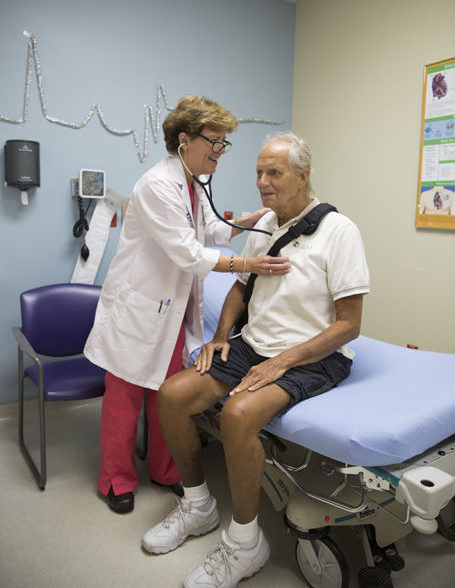
In 2014, Vero Beach’s then-67-year-old Jake Martin was one of those 550,000 newly diagnosed heart failure cases. Today, with the help of some impressive technology, IRMC cardiologist Dr. Richard Moore, nurse practitioner Pat Draper and the hospital’s “shared care” program at the heart failure clinic, Martin and his wife, Pat, are still living active lives here in Vero and Jake is now a regular at his local gym.
That wasn’t always the case. In the tall, lanky Martin’s own words, “When all this started happening I was down to about 150 pounds. I was falling all apart. I was getting weak. I couldn’t sleep.”
His wife Pat Martin chimed in, saying, “He was pretty bad and they were quite worried about him.” So worried, in fact, that Draper referred the couple to an Orlando specialist, Dr. Nirav Rabal, who recommended implanting a left ventricular assist device or LVAD called the HeartMate II.
Commonly called an artificial heart pump, the HeartMate II assists or takes over the pumping functions of the left ventricle and can dramatically improve the flow of oxygen-rich blood throughout the whole body, improving organ functions and increasing the recipient’s energy level so much they are able to resume normal activities.
Now Martin is not only hitting the gym regularly he has also re-gained some 40 pounds.
That’s not bad for a man with no pulse.
Well, sort of no pulse. Moore explains that Martin’s HeartMate II pumps continuously so there’s no perceivable pulse. It is, he explains, “not pulsatile.”
The distinction doesn’t seem to faze Martin in the least. Maybe that’s because he’s being spared the ordeal of driving up to and back from Orlando for periodic checks on his HeartMate II.
The long drives aren’t necessary because Draper can electronically transmit the data from Martin’s pumping device directly to the specialist’s office.
“It saves me that trip that kills a whole day,” Martin says. “It’s so much easier to come right here.”
Draper steps in to add, “It’s important to know that we are one of only three shared care sites in state.”
Meanwhile, Moore takes a somewhat broader view saying, “There’s some fancy, sexy technology here, but there’s also some good, old-fashioned, multi-disciplinary care. We are learning that these patients cannot be taken care of by one doctor, one nurse. These folks need to be taken care of by a team of individuals, which includes, in this case, the heart failure clinic.”
Moore’s enthusiasm continues as he adds, “I think that’s what is most exciting about this because this is a new paradigm to take care of patients. I think what this clinic is achieving is improvement in function and survival of patients with a failing heart. That’s really what we’re doing.”
Generally speaking, heart failure clinics seek to educate patients about their heart health and formulate plans which may involve diet changes, exercise, medication or different high-tech electronic devices that allow patients to set and meet their goals for a longer, more active life.
Draper quickly adds, “If I may interject, there are so many things that can make a huge difference for the patient and their family. Heart failure is like that stone that hits the surface of the pond. It affects everything. … If they don’t understand what they can do in terms of managing their situation, then they’re behind the eight-ball to begin with.”
Billiards analogies aside, something must be going right at IRMC’s heart failure management clinic and the 155 or so patients it sees.
According to Draper, “the national re-admission rate for hospitals is 23 percent, but once patients come to [this] clinic, the re-admission rate is under one percent.”
Additionally, on April 13 of this year, Florida Blue named IRMC a “Blue Distinction” center for cardiac care due to its “low rates of complications and re-admissions” in heart care.
The IRMC heart failure management clinic is directly across from the hospital at 3650 10th Court. The phone number is 772-563-4415.
