
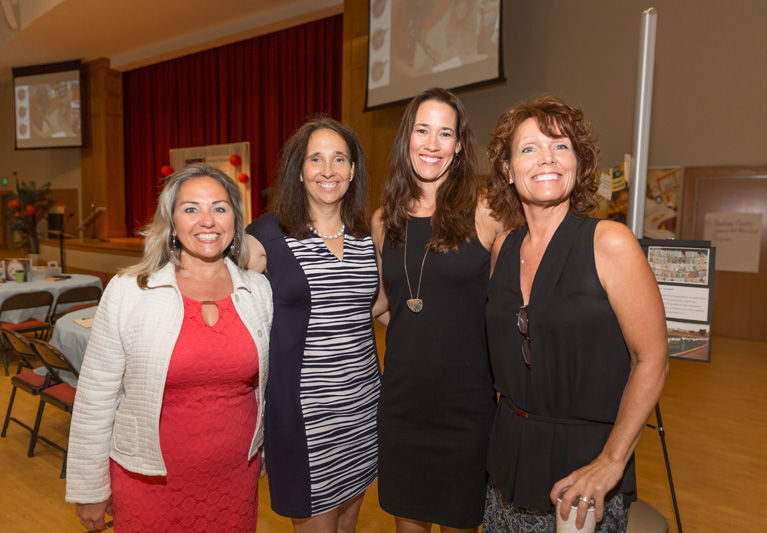
At the recent Moonshot Moment Community Summit hosted by The Learning Alliance, close to 300 community and business leaders, educators, politicians and concerned citizens packed McAfee Hall at First Presbyterian Church to learn how they might help the Indian River County School District achieve the lofty Moonshot Moment goal of having 90 percent of all third grade students reading at grade level by 2018.
“It’s going to take a lot of us to meet this aspirational goal. It really is all of us. The citizens have to own the goal of educating all of our kids,” said TLA Executive Director Barbara Hammond, stressing that third grade marks the transition point between learning how to read and reading to learn. “A Moonshot community follows up on that aspirational vision with action and collaborative learning and doing whatever it takes to get us into that goal.”
Hammond founded the organization six years ago with Liz Woody and stated that studies show school reform efforts take seven to 12 years to take hold. She noted that an astonishing number of families in our community are struggling just to meet basic daily needs. Sixty-eight percent of families are on the free/reduced lunch program, an increase of 50 percent since 2008, and the stress related to that increased poverty is just now showing up in classrooms.
“We need businesses to have healthy jobs. We have not recovered from the 2008 general recession,” said Hammond.
Event moderator Heidi Guber reiterated the importance of community partnerships, saying, “Communities are the nexus of social change. This is not just about literacy. It relates to everything we want to achieve. We’re not the only ones dealing with this issue. This is a national issue and people are looking for solutions. You already are on the map nationally for what you’re doing; you are a national model.”
She stressed the difficulty of attempting to achieve an ideal situation without knowing how to do it; recognizing that breakdowns in the process are often doorways to the next solution. “Your plan is always a hypothesis. It’s not the right answer; there’s room for many,” said Guber.
Michael Kint, United Way of Indian River County CEO, spoke about the significance of the ALICE (Asset Limited, Income Constrained, Employed) Report, representing working families living below the household survival level of $48,323 who are struggling to meet basic necessities such as housing, food, healthcare, childcare and transportation. In Indian River County (based on the 2013 U.S. Census for families of four), 14 percent live below the $23,050 federal poverty level and another 30 percent represent ALICE – meaning close to half the population are walking a financial tightrope.
“The ALICE population is important and it matters to all of us,” said Kint. “We need ALICE to succeed. When we ignore ALICE we risk the future well-being of our communities. When any part of the community is struggling financially, it affects the prosperity of all.”
Hammond said data show proficiency rates of 43 percent for children from impoverished families versus 73 percent for families with resources. National studies show kids whose families are struggling to make ends meet hear 30 million fewer words by the time they’re 3 years old. They come in not ready for kindergarten and our schools aren’t set up to provide the extra time after school to catch them up currently. So there’s a lot of work going on here on how to break that, with afterschool and summer programs to help those kids catch up.”
Indian River County School District Assistant Superintendent Bruce Green spoke about Moonshot classrooms building 21st century skills for today’s workforce by teaching critical thinking, creativity, collaboration and problem-solving.
Green said that while the recent 2015-16 student performance data is discouraging at first glance, a closer look shows improvements in some areas. For example, there have been proficiency improvements among the same groups of students, and the district has seen an overall 12 percent literacy growth in K-3 classrooms. Students who attended two Moonshot Academy sessions (14 weeks) saw a 65 percent literacy proficiency improvement, reinforcing the need for additional extended learning opportunities for students and teachers.
“More and more students are coming to school with greater challenges and less resources, facing challenges that we couldn’t have imagined 12 years ago when the free and reduced lunch rate was under 40 percent. And now it’s moving quickly to 70 percent,” said Green, adding that in addition to academics, teachers must also meet the social and emotional needs of those students.
Crediting former school superintendent Fran Adams with embracing the support of the entire community, Hammond said, “The relationship between the community and the school district is looked on with envy across this nation because school districts do not open up their arms and say ‘come on in and let’s work on this together.’ A Moonshot Community is one that holds the goal and ensures that the goal survives through superintendent turnovers and elected official turnovers, and that’s truly remarkable and historic.”
The day-long summit continued with stories from a number of educators and collaborative partners, and ended with round-table discussions among breakout groups.
Additionally, Ellie McCabe, Alma Lee Loy and Bob Brackett were recognized as the “originators of social change” in Indian River County, with Kerry Bartlett noting, “As a result of their contributions, the community was ripe to catapult the Moonshot Moment forward. Our job is to take it to the next level. They have set the bar very, very high.”
