
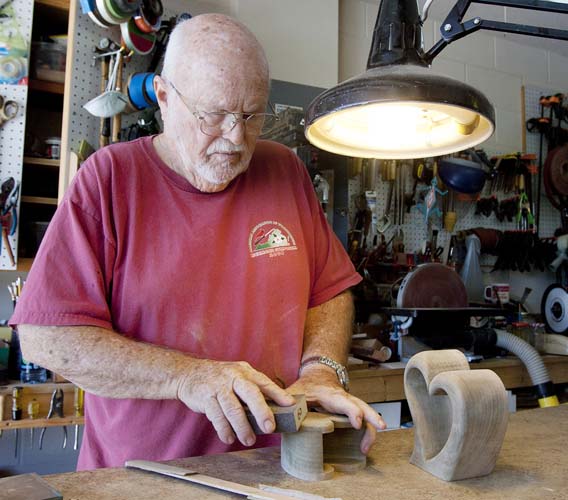
VERO BEACH — Al Gustave sees more than a forest when he looks at trees. He sees inlaid boxes, rocking chairs, bowls, pendants, pens and vessels.
He also sees a palette from which to “paint” his pieces. The names of the trees say it all – bloodwood, purpleheart, yellowheart, rosewood.
The rigors of nature can lend the wood intricate patterns. Even a steady wind on a branch can stress the cells in the tree, leaving marks and striation like a vein of mineral in a piece of quartz.
Take the slab of spalted sycamore stacked in his garage. It resulted from the particular battle of two fungi, in what was once just a stump of dead wood.
Sliced just so, the twists and turns of the competing fungi show up in the wood like a pen-and-ink drawing – the spalting.
Gustave takes the trace of the feeding fungi and turns it into art.
His work won first prize in 3D art in January’s Art-by-the-Sea juried show, staged by the Vero Beach Art Club at the Vero Beach Museum of Art.
He won it for a piece he called “winged bowl.”
“I was blown away because it was such a small bowl among all these big pieces of sculpture,” he says.
He won Best in Show last year with a rocking chair, a version of a piece by the American craftsman Sam Maloof.
Gustave carved the chairs – and immediately sold the one that won for $5,000 – out of large pieces of wood, slicing the wood away by hand to achieve the graceful piece with its curving flat spindles and faintly bowed arms and a seat that dips where the thighs rest.
Woodworking has been a lifelong passion for Gustave – technically, he is called a woodturner, for his use of the lathe – the wood moves while the tool keeps still.
Gustave is a member of two woodturner clubs in Fort Pierce and Melbourne, each with around 40 members.
In July, he’ll go to Tampa to a national symposium on woodturning, helping out with the videography – woodturners love to learn new techniques, and there are beautiful glossy magazines of projects and ideas.
The craft has evolved tremendously with the advent of computer graphics, which now allow the woodturner to lay out intricate patterns with precision.
Cuts can be as tiny as string’s width, when a piece of wood is intended to rim an inlay, for example.
Each morsel of wood must be color-coordinated, and if it has a pattern, like bird’s eye maple or zebrawood, that too has to be aligned.
Gustave holds a small cube fitted together like a puzzle, formed of different shades of wood with Titebond, a woodworker’s glue. Those cubes will be laid end to end in a classic design known as Greek key, then set within a bowl, shaved to a curve and sanded to pearl-like smoothness.
“I have to calculate each angle, and I have to cut each piece to the right depth so when it comes together, it’ll be the right shape,” he says, sliding his finger along the perfectly honed finished piece.
“A neighbor of mine, we cut down an oak tree for lumber wood. Near the bottom, near the stump, it was stressed a lot. It wasn’t good for making furniture because it was knotted from being stressed. It was just a root piece, but I said, ‘Let me take a look at that.’”
Sawing it open, it turned out to be a rare piece of curly oak. Once worked, the stresses, which appear more frequently in maple, for example, became luminescent against the fleck of the oak grain.
He used the curly oak in a shallow flat-bottomed bowl with a checkerboard of bird’s eye maple, bordered by lacewood, another intricately marked wood.
The bowl took him 10 hours to make, he figures.
“I work pretty fast,” he says. “I’ve been doing this for a long time.”
Gustave started carving wood when he was 10 years old. His father, a sign painter, started him on making model cars from balsa wood when he was growing up in Long Beach, Calif.
By 15, Gustave started a club, the International Association of Automotive Models. It still exists today, but when it started, its chief mission was to get them press passes into automobile shows.
“It worked,” he says.
From cars, he took to building model planes and learned to fly. He then studied architecture and engineering in college, and got into interior design.
He took a fancy to Danish modern, the furniture style of the moment that involved sleek lines and lots of exposed, carved wood.
“Danish furniture was being imported into New York by three people. They had it locked up. Prices were so inflated that you couldn’t afford it. So I went and borrowed the money to go to Europe, and I went to furniture makers in Norway, Denmark and Sweden and I said, ‘Why don’t you sell it to me for the southern U.S.? I’ll bring it in through Newport News, Virginia.”
He did, and kept a number of pieces for himself, including the elegant carved chairs at his breakfast nook table.
In 1963, he moved to Scottsdale, Ariz. There, he began designing commercial spaces like banks and hotels, including designing and building the fixtures and shelving as well as desks and tables.
“The nice thing about my business was that I had the availability of designing the furniture and making it in my shops. I could custom design anything for you.”
In 1978, his firm was hired by the National Park Service to re-do two lodges, the Kachina and the Thunderbird, at Grand Canyon National Park.
“I made all the furniture for those rooms, even the light fixtures.”
In the late 1980s, he started a manufacturing business that made decorative accessories, and travelled across the U.S. to national gift shows selling at wholesale merchandize of his own design.
He sold his business around 2000 and retired first to Virginia, then North Carolina. At the invitation of friends, he and his wife Mary visited Vero Beach and decided to move here.
A member of the arts council in Edenton, Gustave immediately became involved in the Vero Beach Art Club, signing on to the Art in the Park committee. He has been leading the drive to build a permanent home for the club, founded in 1936 and currently based within the art museum.
“I’ve never been around a group of people that are so friendly and cordial and helpful,” he says of his fellow club members. “And I love the creativity that comes out of that group.”
Gustave gives lessons in woodworking in his garage, noting there is no shop within the education wing at the museum.
“If you want to learn to use the table saw, or the band saw, I can teach you.”
Gustave consigns his pieces through the Artists Guild Gallery in downtown Vero.
