
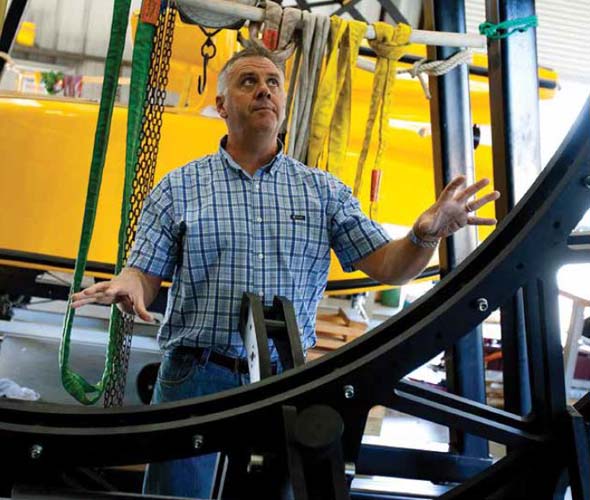
VERO BEACH — Triton Submarines President Patrick Lahey says his company has reached a tipping point that will help keep it on track to expand production at its facility near the intersection of State Road 60 and Interstate 95 from one or two submarines a year to five or six.
The submarines, which cost between $2 million and $3 million and carry either two or three people, have six-inch-thick spherical Plexiglas hulls that offer unobstructed views in all directions.
Two currently are being built at Triton’s boatyard.
“This year for the first time I have had big yacht manufacturers come to our booth at trade shows and say they want to consult with us to incorporate submarine storage and launch capabilities into ships they are building,” says Lahey, 50, a dynamic, enthusiastic man who fell in love with the ocean when he was seven and has been in it or on it much of the time since then.
Triton makes two main types of mini-submarines, also called submersibles – ones that can go 1,000 feet below the surface of the ocean and ones that can descend safely to 3,300 feet.
The larger and more popular 3300-series subs weigh 17,000 pounds. Retrofitting the super yachts of the superrich to handle a toy like that on the open sea is a difficult and expensive engineering challenge that has been a drag on the marketability of submersibles.
Now, though, as word of the reliability and capabilities of mini-subs spreads through the yachting world, and more yacht buyers ask manufacturers to build sub storage and launch facilities into their new boats, Triton’s market is expanding, Lahey says.
Still, new super yachts cost $50 million to $100 million, meaning they are owned only by the richest of the rich, people who have hundreds of million or even billions of dollars – a tiny demographic for any company to target.
To create a bigger pool of potential customers, Triton recently designed a luxury catamaran built specifically to carry and launch its 3300-series submersibles.
“The catamaran costs about $1.5 million,” says Triton Vice President of Sales and Marketing Marc Deppe.
That means a customer can get a fast luxurious boat with a comfortable cabin and 1,000-mile range and a safe, elegant, highly-maneuverable submersible for a total of $4 million to $5 million – which puts the subs within reach of many more people.
The electric-powered craft can stay underwater for up to 10 hours. They maintain atmospheric pressure inside so there are none of the dangers or delays associated with scuba diving when descending into or ascending out of the ocean depths.
“We call it a shirt-sleeve environment,” says Deppe.
With four thrusters, Triton submersibles can pivot, cruise in any direction and tilt forward or backward to bring occupants eyes within a foot or so of anything on the ocean floor.
“The Plexiglas hull refracts light almost exactly the same way water does,” Deppe says. “That essentially makes the hull disappear when the sub dives. It is kind of freaky the first time you experience it. People have a tendency to reach out and touch the Plexiglas to make sure it is still there.”
Triton’s technology is far beyond not just anything that existed but anything that could have been imagined when Lahey had his first childhood encounter with the ocean on a beach in Barbados.
“I am from Ontario, originally,” he says. “My dad was a builder and he was building some houses in Barbados so we moved down there when I was seven and lived there for three years.
“I had never seen the ocean before and I fell absolutely head-over-heels in love with it.”
Lahey learned to SCUBA dive when he was 13 and went to a commercial dive school in Los Angeles after high school, learning underwater welding and other skills.
“I did well in the school because it was something I was so passionate about, and I was lucky to have a great career in the diving industry,” Lahey says.
He worked for diving companies servicing oil fields in the North Sea, the Gulf of Mexico and the Pacific Ocean near Santa Barbara.
There, he first worked on and operated manned submersibles.
When mini-subs were replaced in oil fields with cheaper, lighter ROVs – remotely operated vehicles – Lahey went on to work with submarines in other settings, including Harbor Branch where he was involved in the Space Shuttle Challenger recovery in 1986.
He also worked for the Canadian company that makes the Atlantis tourist subs found in Barbados, St. Thomas, Hawaii and other locations and for James Cameron on the documentary “Aliens of the Deep.”
In the early 1990s, Lehay met and went into business with Triton CEO L. Bruce Jones, who had grown up “living on heavy marine construction platforms in the South China Sea and the Persian Gulf” and “learned to dive at the age of nine under an oil tanker terminal seven miles off of Kuwait.”
The two men formed a company called U.S. Submarines that they still own.
“We worked on a variety of designs – diesel electric subs, big tourist subs and, as it happens, the first Triton. But it was way too soon,” Lahey says. “People weren’t ready yet for a small recreational submarine. When we talked about the idea at trade shows, they looked at us like we were lunatics.
“About 10 years later, we decided it was time to take another run at it. We felt this market was about to become a significant one and we came up with what we thought was a compact, lightweight and fairly elegant design, the 2/1000,” that can take a pilot and passenger 1,000 feet deep.
“I pitched it to a guy in Florida and we delivered our first submarine in 2007.”
Triton set up shop in Vero Beach because of the deep-ocean engineering and exploration talent generated here by Harbor Branch Oceanographic Institute, a pioneer in the development and deployment of submersibles.
“Half a dozen of the guys who work here are former Harbor Branch employees,” says Lahey. “We have access to a fantastic team of people in Vero Beach.”
Most of the precision parts that go into the submersibles are manufactured elsewhere for assembly at Triton’s Vero headquarters. The company also does design and electrical work onsite.
There is no direct government oversight of the manufacturing process but mini-submarines are regulated and certified by the American Bureau of Shipping.
Deppe says they are the safest form of transportation in the world today.
“ABS classed submersibles have carried about a million passengers a year for 20 years and to date they have a perfect safety record. There has never been a serious injury or fatality to any passenger aboard an ABS classed sub.”
Triton provides a 14-day training course to whoever operates one of their subs.
Deppe says the subs don’t usually have a dedicated crew. Instead, an engineer, mate or captain on one of the large yachts where they are typically deployed learns to pilot and maintain the submersible.
The subs have a heavy aluminum frame that holds the Plexiglas hull and a wide variety of equipment can be attached to it, including grabber arms and video cameras for undersea filmmaking.
Triton got some valuable publicity when one of its 3300 submersibles was used in the Japanese expedition that filmed a giant squid for the first time last summer.
The submarine was seen nationwide on Sunday when Discovery Channel aired “Monster Squid: the Giant is Real,” a documentary about the expedition.
“Four Triton people went along to service and operate the submersible,” Lahey says. “We are very proud of our participation in that scientific achievement.”
Lahey and Jones plan to expand beyond the 1000- and 3300-class subs they now offer. In addition to the submersible- carrying catamaran, they are designing a small personal submarine capable of going to the deepest parts of the ocean, the Triton 36000/3, which will be able to dive to the bottom of the Mariana Trench with a pilot and two passengers.
They also have plans on the drawing board for an undersea resort where well-to-do eco-tourists will pay $15,000 a week to live and go SCUBA diving on the sea floor in a colorful tropical lagoon.
