
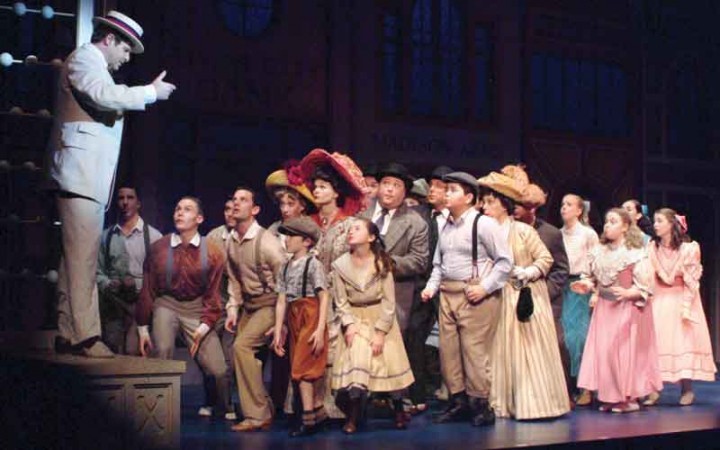
VERO BEACH — Like a patriotic pop-up book suitable for the entire family Riverside Theatre’s robust production of “The Music Man” springs to life as surely as corn grows in Iowa. Meredith Willson’s Tony Award-winning homage to quaint Midwestern Americana is a nostalgia-packed classic.
Directed and choreographed by Vince Pesce, “The Music Man” confidently serves up the goods of song, dance, comedy and heart. While some might find the well-known dated, for others, it’s the quintessential “feel-good” evening at the theater.
First things first: can anyone other than Robert Preston capture the role of Professor Harold Hill, the con artist masquerading as a traveling band instructor?
Preston immortalized the role of Hill in both the 1957 Broadway production and the 1962 movie version. For all practical purposes, Preston is Hill.
So can anyone play the part and not be compared to him? Probably not.
But Tony Lawson’s perfectly chiseled jaw, confidence-inspiring baritone, and fleet feet do not disappoint.
Lawson’s got the requisite chops to scam the gullible rubes of River City and make us love him at the same time. In fact, we’re rooting for him to pull it off.
We’re not the only ones to find him irresistible, of course.
There’s Marian Paroo the town librarian played by the lyrically lovely Jennifer Hope Wills and her lisping little brother Winthrop (the delightful Luke Kolbe Mannikus).
When Winthrop gets his hands on the long-awaited coronet and finally starts to talk, the young Mannikus briefly steals the show.
Most importantly perhaps, as Hill and Marian, Lawson and Wills have the right push-pull chemistry. When Hill finally takes Marian in his arms on the footbridge and kisses her – really kisses her – we love it.
We know the story: traveling salesman Professor Harold Hill fleeces small-town suckers and his current game is selling boys’ bands.
He plans to convince the citizens of River City, Iowa, that the town’s new pool hall is the first step on the road to degradation.
Once Hill pockets the money from instruments, uniforms and instruction books, he’ll grab the first train out of town.
What Hill doesn’t plan on is falling in love with the town librarian Paroo. That’s both his downfall and his redemption.
“The Music Man” is that American fable: decent small-town girl reforms city slicker as both resist the mutual attraction but eventually find true love.
You can buy into the premise with wholehearted abandon or you can find the concept a bit too predictable.
Regardless, there’s a reason why “The Music Man” ran for 1,375 performances when it opened on Broadway in 1957, winning the Tony Award for best musical.
There’s a reason why the 1962 movie version is in the National Film Archives and why the play continues enjoying countless revivals.
It’s funny, it’s hopeful and it’s brimming with great songs.
From the foot-stomping “76 Trombones” to the intricately subtle “Marian the Librarian” (beautifully choreographed here by Pesce), Willson goes from marching to lyrical. And Willson has an uncanny gift for taking the way people talk and turning it into music.
Take the first song of the show, “Rock Island” sung by Charlie Cowell (the excellent David Schmittou) and the traveling salesmen.
Inside a clickety-clacking train car, a handful of traveling salesmen read their newspapers. The bantering conversation, complaints about how the sales business is changing, becomes the song. The music, the lyrics, and the performers movements are perfectly syncopated with the rhythm of the train as one singer cuts in on another griping about the travails of life on the road.
Willson’s lyrics capture their rhythm building to a staccatoed frenzy.
“Ya can talk, ya can talk, ya can bicker, ya can talk, but it’s different than it was,” sings the first salesman.
“No it ain’t, no it ain’t, but ya gotta know the territory,” sings Charlie, an anvil salesman with a grudge against Hill.
Compare that comical cacophony to the dreamy Barber Shop Quartet classic “Lida Rose” and the heartfelt solo “Goodnight, My Someone” as sung by Paroo, and you’ve got an impressive contrast in style.
Then there’s Hill’s first sales pitch to the town: “Ya Got Trouble”. It has all the evangelical zeal of Elmer Gantry.
We’re thrilled when Hill turns his blazer inside out revealing a red band jacket and mesmerizes this taciturn crowd of contrarians who have just been snubbing him.
Within seconds, Hill’s got them got believing that a pool table will lead their sons straight to hell.
“Ya got one, two, three, four, five, six pockets in a table, Pockets that mark the difference between a gentleman and a bum with a capital “B” And that rhymes with “P” and that stands for pool!”
Allen W. Cornell, Riverside Theatre’s producing artistic director, designed the impressively versatile sets and they’re pure Winslow Homer.
Here are cornrows and red barns, the Paroo’s cozy living room, and the footbridge near the picnic ground.
Jody Madaras stands out as the lanky Marcellus Washburn, the only one who knows Hill from a previous life and knows his real name, Gregory.
All arms and legs, Madaras tries to rescue Hill from the police.
David Schmittou does a deft turn as the comically evil anvil salesman with enormous sideburns who’s determined to bring down Hill.
Why does Charlie Cowell want revenge on Hill?
Early on, Cowell shows us his skinned head, claiming that it’s Hill’s fault he was tarred and feathered.
Also excellent are the bumptiously self-important Mayor Shinn (J. B. Adams) and Beth McVey. Israeli-born Netaniel Ballaishe is outstanding as the boy with the bad reputation, Tommy Djilas, who’s in love with the mayor’s wide-eyed daughter, Zaneeta Shinn (Jessi Trauth).
And there’s a special treat: seven cast members are children and two of them are Riverside Children’s Theatre veterans, Mekenzie Moses (daughter of Jon Moses, Riverside Theatre’s managing director) and Piper Wild.
Moses and Wild are members of the ensemble and understudies.
“The Music Man” is a good-natured slice of apple pie with a flag stuck in it. Most definitely, it’s packed with talent.
Nonetheless, we’re hoping Cornell give us some theater with an edge, not just a steady diet of happy musicals. We’re looking at the remaining two shows scheduled for Riverside’s Second Stage, the venue for an alternative experience.
Starting March 15, it’s “The Gin Game” followed by “Bridge and Tunnel” replacing the originally scheduled “Six Dance Lessons in Six Weeks, which plays April 19 – 29.
We’re hoping they offer some theater we can sink our teeth into.
The last production on the Main Stage, “A Funny Thing Happened on the Way to the Forum” plays April 5 – May 6th.
“The Music Man” runs on Riverside Theatre’s Main Stage through March 18. For tickets and information contact www.riversidetheatre.com or call (772) 231-6990.
